Built to fit your farm, not the other way round
In most farm products, someone decided years ago what a paddock is, what you’re allowed to record about a mob, and what goes on a spray record. Those decisions are set in concrete. Changing one means a new version of the software, and your particular need has to be worth building for everybody else as well.
Alffi doesn’t work that way. What you keep records on, what goes on each one, how they join up and what gets worked out from them are all things you set — not things we built in before we’d met you. Adding a new kind of record is about as involved as adding a new paddock.
That one difference is what makes everything else on this page possible. It also means the way your place is organised can exist in Alffi without anyone here ever knowing about it.
Animals, pumps, chemicals, paddocks, jobs — and whatever else your place runs on. If you need to keep track of something, you can, whether or not we thought of it first.
Set up a new kind of record yourself, with the details you care about on it. From then on it behaves like everything else — it lists, it searches, it goes on the map, and it turns up in reports.
Words, numbers, dates, yes or no, a list to pick from, a photo or a document, a spot on the map, a link to another record. Make the ones that matter compulsory, fill in the usual answer by default, and hide the ones that don’t apply.
A pump sits on a property, an animal runs in a mob, a slasher goes on a tractor. Because Alffi knows how they connect, it can answer a question that crosses all three without you joining it up by hand.
Say what you want in plain English — “weight gain divided by days on feed” — and Alffi produces the formula, runs it against your real records, and shows you the answer before you save it. If the preview is wrong, nothing has been committed.
Three things make this safe rather than clever:
Kilograms divided by days gives kilograms per day, and Alffi knows that. Values are stored in standard units and converted for display, so a formula can’t silently add pounds to kilos.
A calculation works out a number from your own records, and that is genuinely all it is able to do. There is nothing else it is allowed to reach.
Delete a field a calculation depends on and Alffi refuses, showing you exactly which formulas rely on it. Broken calculations don’t appear months later in a report.
Anything you keep track of can have a spot on the map, or a boundary drawn around it. Paddocks are the real shape of the ground, not a name and a number of hectares you typed in. Gates, tanks, pumps and hydrants are places you can drive to.
Most farm mapping treats every paddock as its own independent shape. Draw two paddocks either side of a fence and you get two separate records for the same physical strainer post. On screen they sit on top of each other and look correct. Then someone corrects one of them, and the boundaries quietly drift apart — two versions of a fence that exists once in the world.
Alffi models your farm as a graph of shared posts. A corner used by two paddocks is one record, referenced twice. Drag it, and both paddocks are reshaped in the same transaction. There is no version to go stale, because there is only one post.
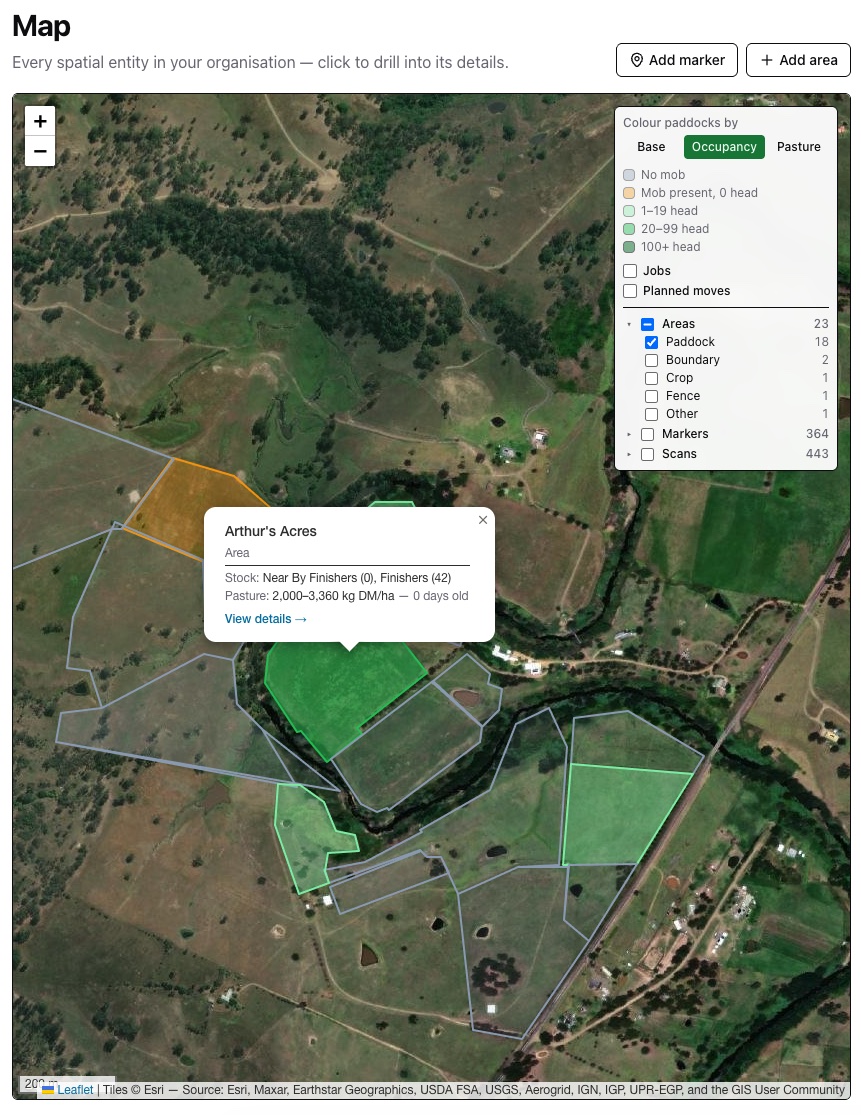
When you draw, existing posts show as targets. Click one and you reuse it rather than creating a duplicate a metre away. Before you save, Alffi tells you how many posts it will create and how many it is reusing.
Move a corner that another paddock relies on and Alffi says so first — naming how many points are shared and what else will change — rather than surprising you after the save.
Area and perimeter update live as you drag, and are always recalculated from the posts themselves. If a stored figure has drifted from its own boundary, the map tells you and offers to fix it.
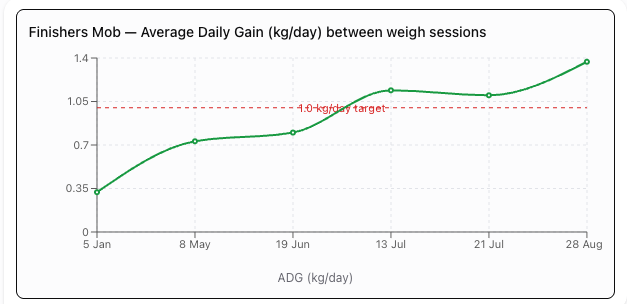
You put a mob through the yards yesterday. The weight on the bar isn’t really the question — the question is whether it beats the last drafting, whether they’re gaining the way they should be, and whether they’ll be ready when you need them.
Most software can’t tell you, because yesterday’s weight wrote over the one before it. Alffi never writes over a reading.
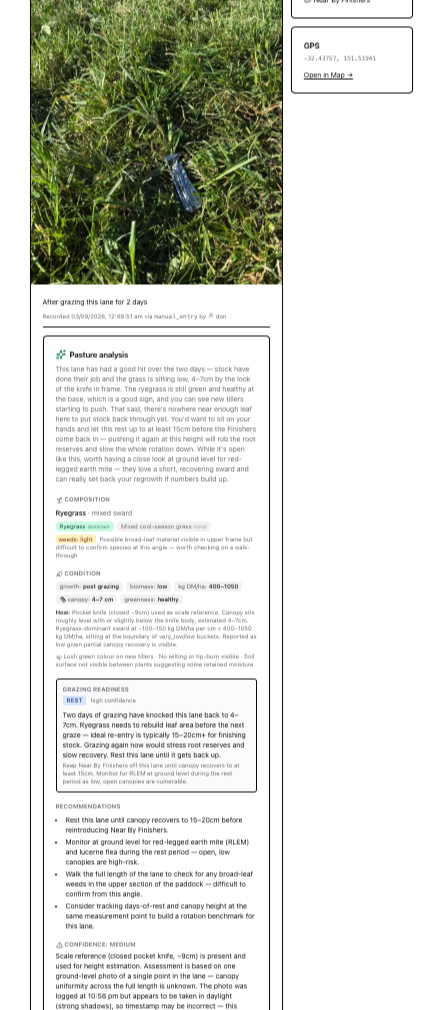
Some of what you want recorded is easier to photograph than to describe. Take the picture where you’re standing and Alffi writes up what it sees — and files it as a dated, located record like any other.
The unglamorous part, which is usually where farm software actually fails.
Setting the place up — adding a new kind of record, deciding what goes on it, turning modules on, bringing old files in — is deliberate work you do occasionally, sitting down. Alffi treats it that way.
The daily work is the opposite: constant, one-handed, in bad light with gloves on. So it’s shaped around what you’re doing rather than what the software calls it. Record a weight. Move a mob. Log the fuel. Nobody out there should have to think about how any of it is set up — and they don’t.
Usually it’s the same person doing both, often on the same day. What changes is the screen in front of them, not what they’re paying for.
Setting Alffi up around your own operation is the part that is well worn in. These are the rough edges.
Bring us a structure your current software can’t model. That’s the interesting demo.